
By Dr. David Smith
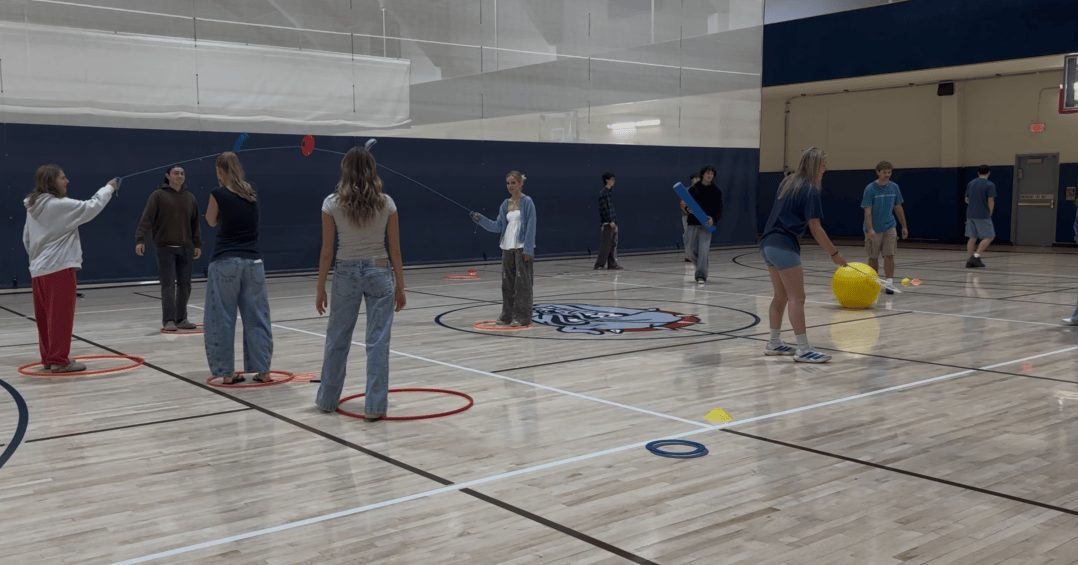
Standing in the middle of the basketball court at the university gym, with fitness and sports equipment randomly sprawled all around, I asked my Gen Z students, “who here has heard of Calvin and Hobbes?” Sadly, all I got was silence. Today, in my class “Motor Development and Learning”, we had a lesson in the direct applications of The Constraints Led Approach by playing Calvinball!
As an extension of Ecological Dynamics which posits human movement, skill development, and decision-making behaviors as emergent based on a direct coupling of an individual and their environment (Smith et al., 2022). The Constraints Led Approach (CLA) represents a coaching philosophy in technical and tactical development rooted in discovery. By establishing the basic parameters of the task, including outcome goal as well as boundaries; you create a space that empowers the athlete to:
- Explore the various options available to them.
- Experiment and try new things.
- Pursue risky options and take their chances.
- Enhancing creativity and think out of the box.
- Develop problem solving skills and task oriented thought processes.
- Help them learn for themselves what is the best way.
The CLA runs counter intuitive to traditional coaching models which are rooted in giving step by step directions and telling the athlete what the “correct” method to use it. These traditional models impose limitations that inhibit an athlete’s creativity by assuming that the taught is the correct and “only” way to achieve the task. Yet, some of the most defining moments in human history happened as a result of creative solutions and out of the box problem solving skills.
From the moment we are born, our exploration and discovery of the role is rooted within the Constraints Led Approach. We discover new sensations and motor skills that we develop. Helping develop our knowledge of perception as we interact within our environments. Yet during our most formative years this curiosity of exploration is often suppressed with the imposition to conform and do as we’re told. So how do we break free from that to rediscover our ability to explore and take chances to try new things?
Well, when you have 45 minutes to do just that, you play Calvinball!
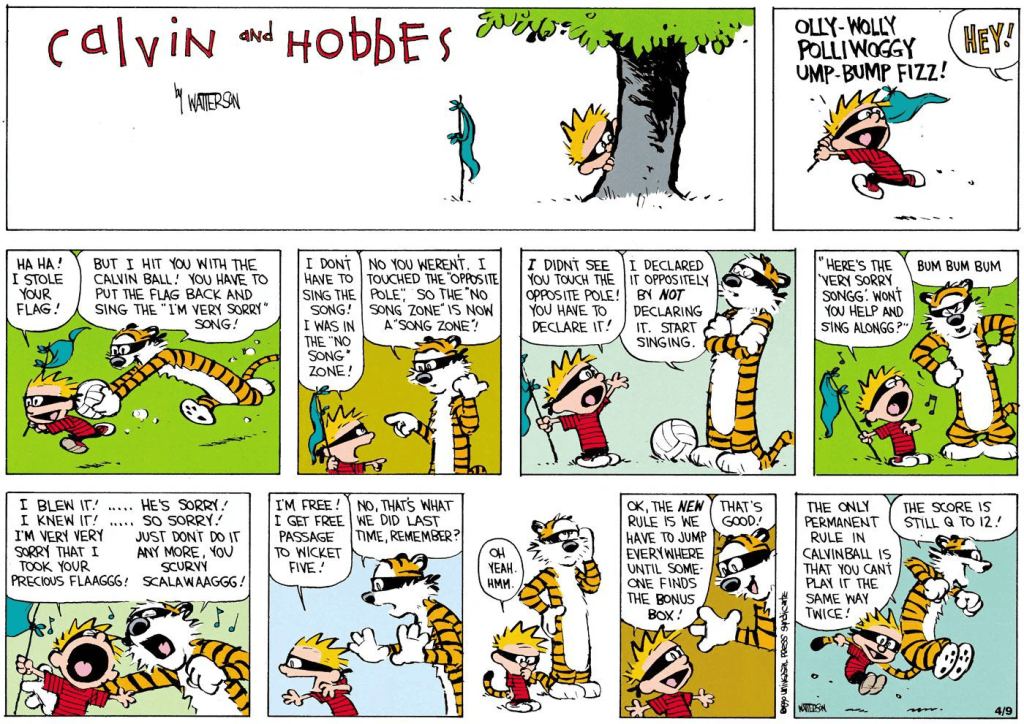
Calvinball is a game developed by the titular character in Bill Watterson’s comic strip, Calvin and Hobbes. Throughout the series, Calvin and his tiger buddy Hobbes are seen playing Calvinball many times. The game is simple in that the only permanent rule (constraint) is that the game can never be played the same way twice. Otherwise, the game is entirely made up as it they go along (Watterson, 2002).
Taking my students to the basketball court, we distributed various pieces of sports and fitness equipment, balls, sticks, hula hoops, cones, jump ropes, and other things randomly around the court. Here’s how we played:
Game
- Players can offer points by challenging each other with various tasks.
- Players can impose penalties on each other.
- Player with most points wins.
Constraints
- Players can only earn points once per challenge.
- Game is never played the same way twice.
- Players must stay within our designated area.
- Players must play safe, nobody gets hurt.
With those constraints set, let the game begin! Calvinball is chaotic, dynamic, and can escalate very quickly! To the outside observer, it looked like a bunch of kids just going crazy with a bunch of random sports equipment, and that’s exactly what we’re doing. Yet within all that chaos there was some semblance of order, only seen by those who knew how to look. Throughout the game we started to rediscover our imaginations, a confidence and courage to try new things, let loose and have some fun. The challenges become more complex, teams and alliances formed, leadership emerged while both collaboration and competition were fostered. Through all the chaos the players explored the game through adaptive skill and creativity in problem solving. By inventing new rules, coming up with new challenges, and finding creative solutions they are discovering the capabilities to think outside the box. Breaking free from the constraints that we are conditioned to act within and impose upon ourselves.
This was the first time I ever played and/or led a session of Calvinball with anybody else ad it was a hot mess. Absolutely perfect for what it was meant to be. As we discussed the game and reflected upon our experience, my students found it to be a lot of fun, activating, engaging, different, and quite refreshing. Especially for an 8am college class on a Friday morning. Next time we all play I expect the game to be vastly different and even more chaotic and dynamic as we develop our skills in play. I am looking forward to it.
Citations
Smith, D., Zaal, F. T. J. M., & Memmert, D. (2022). Emergent coordination of heading in soccer: Of two players and a single ball. Research Quarterly for Exercise and Sport, 94(4), 959–965. https://doi.org/10.1080/02701367.2022.2088674
Watterson, B. (2002). Calvin and Hobbes Sunday pages, 1985-1995: An exhibition catalogue. Scholastic.

 stonewallperformance.com