

By David Smith, M.Sc., CSCS., SDL (He/Him)
There is no love loss for goal setting in the field of sport and exercise psychology. Even further, the entire foundation of sport and exercise, as a field of science and as a multi-billion-dollar industry is all about setting goals. From weight loss goals to achieving medals, establishing consistent habits and routines. All things that practitioners and researchers depend on when trying to understand and influence motivation, change of behaviors, developing healthy habits and discouraging unhealthy habits.
Every personal trainer, fitness instructor, coach, sport/exercise psychologist, survey, everybody and everything will ask you, what are your goals? Good question.
How do we define a “goal?” what do we mean when we say, “long term” and “short term” goals? What does SMART mean? Why should I care?
For me as a sport and exercise psychology researcher and practitioner, where I am also a coach, personal trainer, fitness instructor, teacher, athlete, and all these other things. I tend to emphasize goals as well. Goals give us guidance and direction for which we use to develop our working philosophies and fundamental approach to everything we do.
Yet, for all the research, knowledge, and opinions on what constitutes best practices in goal setting, I have always struggled to find a system of reinforcement that works to keep myself and my athletes accountable. Sure, we set some goals at the beginning of the season, and then we internalize them and away we go until we achieve them and celebrate. But as practitioners, we can do better, much better.
Starting with the classic SMART acronym, goals should be Specific, Measurable, Achievable, Relevant, Timely. This is an enduring approach to goal setting for good reason, it’s effective. When you can set your goals up based on SMART, it helps with the process.
The missing element here is the iterative follow up, reflection, and sense of accountability that is required to sustain us throughout our journey to achieve our goals. Also known as the Action Cycle.
Sure, we set long term goals and short-term goals, but how often do we revisit this goals and follow up on them to ensure we are on the right path? How do we adapt our SMART goals based on the obstacles of life? This is where traditional goal setting processes fall short. It’s a very broad and vague process, because there is none. But to figure out such a process doesn’t require anything new or groundbreaking, we’ll just swipe it from someone else.
In the field of Strength and Conditioning, periodization represents the foundation for which athletic physical conditioning is built upon. Whether it’s a season or an Olympiad, a periodized program takes a long-term goal such as qualifying for the Olympics or competing at a championship and breaking it down into manageable chunks based on our starting point and goal. The periodization approach considers three iterative cycles that, like fractal geometry, contain self-similarity within the structure regardless of scale. Think about the process like a tree, with your large and stable trunk, branching off into branches of various sizes, and eventually into twigs and leaves.
Microcycle: Minutes/Hours/Days – Short term (twigs and leaves).
Highly specific, but flexible and adaptable based on current state. Focused on the process goals and performance goals.
Mesocycle: Weeks/Months – 4-8 Microcycles (branches).
Specific but flexible with a more general sense of direction. Focused on performance goals and outcome goals. Exist on different levels depending on how you chunk it based on your macrocycle goal.
Macrocycle: Months/Semesters/Seasons/Years – Long Term (trunk).
More general than specific, adaptable based on progress of micro & mesocycles, primarily focused on outcome goals. Multiple macrocycles with multiple goals stretched out over a long period of time. At the same time, you might not even have a macro-goal at all, it might take you some time to figure that out well after you start the task. That’s the beauty of keeping it more general. As the Macro-goal gets closer to achievement it can also become your next meso- and even micro goal.
Each SMART goal is defined based on the cycle for which you set it for and the emphasis on the different elements of SMART are based upon the scale of the cycle. One thing to consider is that the goals set within each level of the cycle will change based on the timing of that goal within the cycle.
Specific – How specific is your goal?
– Microcycle: Highly specific to the point of breaking down each individual step and element as a process. Individual leaves on your tree.
– Mesocycle: Generally specific, offering specific direction and guidance with a measure of performance. Multiple leaves attached to a branch. Multiple branches attached to the limbs and trunk.
– Macrocycle: Highly general, offering guidance and direction with an emphasis on the outcome. Limbs and trunk of the tree.
Measurable – How do you measure (performance/outcome/ process goals)?
Measure of goals isn’t always quantified, but can be measured qualitatively as well, or even as simple as a “yes/no” depending on if it’s a process, outcome, or performance goal.
– Microcycle: Process and performance goals here are directly measured based on the development of the process itself in comparison to the previous microcycle and leading to the next iteration and toward the next mesocycle.
– Mesocycle: Based on the status of performance within the process of the microcycle shaped by the that of the previous mesocycle.
– Macrocycle: Do the mesocycle and microcycle goals reflect upon the direction of the outcome goal for the macrocycle?
Attainable – What level is this goal attainable relative to your current state?
Attainability is subject to flexibility but also is not always well established from the get-go, it may require a few micro and meso cycles to establish a baseline first.
– Microcycle: Attainability is reflected within the short-term iteration of the microcycle. That is, can you attain the goal within the next one-three microcycles?
– Mesocycle: Based on the results of the previous mesocycle, how attainable is your next goal.
– Macrocycle: Is this goal attainable within the long-term pursuit of your macrocycle
Relevant – How important the actions toward achieving (or preventing) your goal?
– Microcycle: What actions are important right now that you need to take (or inhibit) toward achieving your next micro/meso/macro goals.
– Mesocycle: What are the important action behaviors and habits do you need to develop between now and the next mesocycle to achieve that goal?
– Macrocycle: What is your long-term mindset and habitual behaviors do you need to develop toward pursuit of your macrocycle goals?
Timely – What is the timeline for each level of goals.
– Microcycle: Can range anywhere from minutes, hours, to days. Maximum one week. What are your goals for the day? For the week?
– Mesocycle: Can be chunked based on both microcycle and macrocycle goals. Ranging anywhere from 4-8 microcycles to having mesocycles within mesocycles such as breaking down an academic year (macrocycle) into two semesters (mesocycle #1) and further into months (mesocycle #2). Which are then broken down into microcycles.
– Macrocycle: Timed on any long-term scale ranging from a several months to several years, relative to the uniqueness of the goals and person pursuing them.
Of course, these iterative cycles of goal setting only truly work when you engage the action cycle for which is an ongoing process of planning, action, reflection, and learning.
- Plan: Establish your micro/meso/macro goals, break them down via the SMART and establish your process for the next cycle.
- Action: Execute the plan as established, keep it flexible enough to adapt to the sensitivity of your initial conditions and fluctuations within your environment.
- Reflect: At the end of each cycle, ask yourself the following questions…
- Were my goals achieved?
- If so, what made them a success?
- If not, what made them fail?
- What went well?
- What could I do better?
- Were my goals achieved?
- Learn: Based on your reflections and answers to your questions, break down the previous cycle and extract the lessons you can learn from it. Apply them into the planning phase of the next cycle.
- Repeat the cycle.
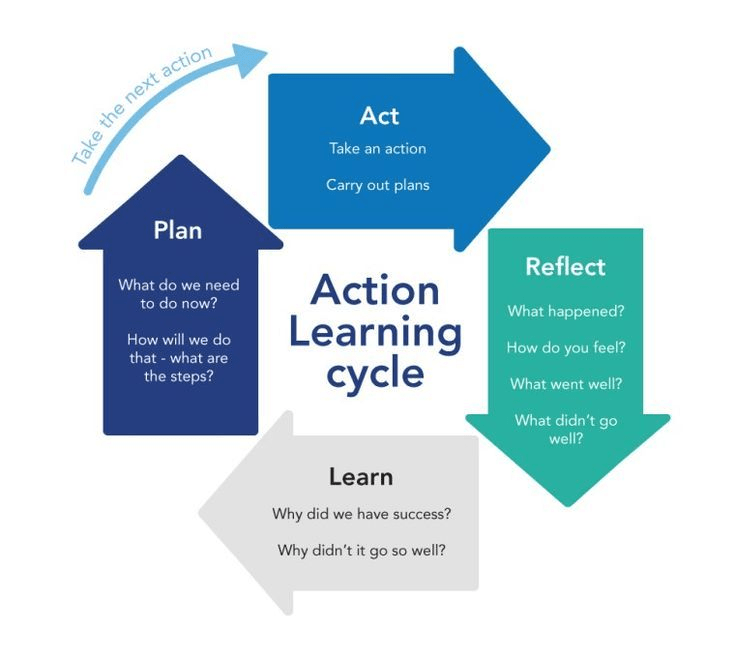
The Action Cycle is part of a greater Growth Mindset which is the self belief that your own skills and capabilities can be improved overtime. Through reflective processes and willingness to learn, you can develop your own skills and capabilities across any number of avenues to achieve things you might have never thought possible. It takes a moment to figure it out, but once you establish the initial process and get moving with it, it’s easy to keep up with. Consider keeping a journal for which you record each cycle and have a record of your goals.
- Keep record of your journey and the development of your goals. You can even record your own thoughts and feelings along the journey, helping better express yourself and deal with the challenges you will face.
- Maintain a personal sense of accountability to keep going.
- Remind yourself of your goals and allows for deeper reflections of the process.
- Looking back on how far you’ve come when you accomplish those goals.
What are your thoughts and experiences? Share with me!

 stonewallperformance.com
One thought on “Scales of Goals: A Cyclical Periodization Approach to Goal Setting and Maintaining Accountability”