
By David Smith, M.Sc., CSCS., SDL (He/Him)
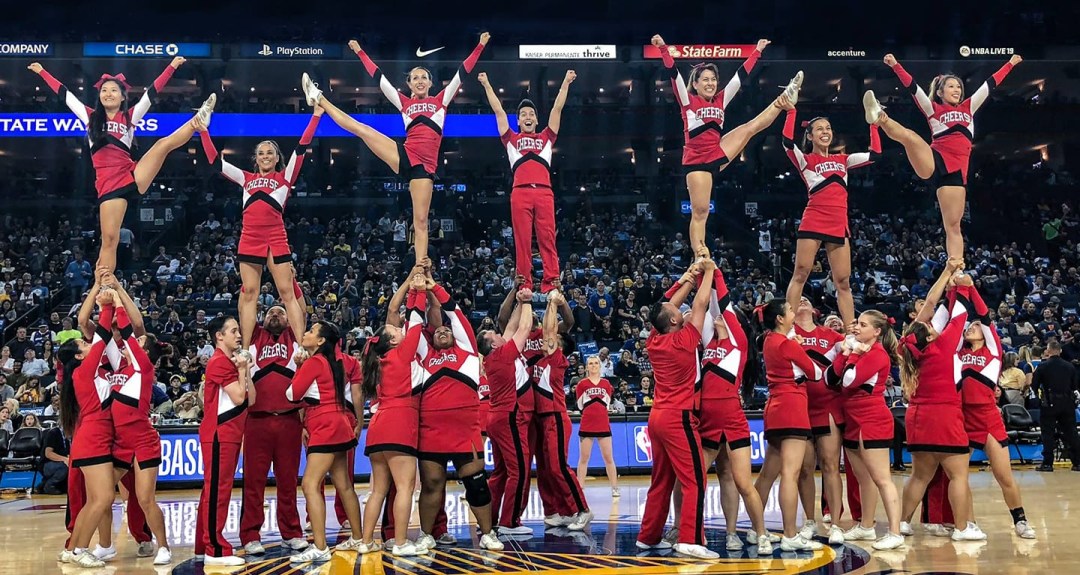
Photo Credit: Cheer San Francisco
Growing up in the USA, my education journey through school and university always had a mark for school spirit and identity shaped by a school mascot and colors. We had fight songs, cheers, chants, traditions like homecoming and such. Much of it wrapped in athletics, but often expanding further out to incorporate other parts of the school, from music and arts to the school’s newspaper, yearbook, and photography clubs. So, it was quite a culture shock for me when I moved to Germany to attend graduate school, at a university centered around sports, that there was no school spirit, no athletics teams, no mascot, nothing.
Living in Germany and explaining the concept of school sports and how a women’s pre-season volleyball game can fill 92,000 seats in a football stadium. It was as much foreign to my European friends as I learned that the construct of “school spirit” is purely an American export.
The “sport experience” of competing and performing in front of a large crowd is such a unique experience. I’ve attended Bundesliga matches, German Ice Hockey league games, NFL, NHL, MLS, MLB, NBA games, university games, I was even in my high school’s marching band and played a lot of football games in pep band. It’s such a fun, high energy experience, both as a spectator in the crowd as well as an athlete on the field.
How does the energy of the crowd affect sports performance? I’ve attended more than a few matches at universities in which there were no cheerleaders, no pep band, no mascot, just nothing but a thin crowd and the athletes playing. Some recent team sport matches I attended I was falling asleep, and I am pretty sure the athletes were too as there was immense social loafing within the team itself. It was enough to inspire me to write this post.
The research out there tries to explore everything from home field advantage to probabilities of winning. What we do know in a general sense that yes, the audience/crowd has a major influence on the performance and energy of the game from all teams. The higher energy the crowd, the higher the standard of performance and energy from all teams and athletes in the match. This is known as the audience effect (Strauss & MacMahon, 2013).
The Audience Effect represents the audience-performer relationship for which the energy and activation of the audience has a positive correlation with the arousal and performance of the athletes. A more engaged and excited audience = stronger athletic performance = more intense and exciting matches.
The audience and performer (athlete) are inextricably coupled given the audience is there specifically to spectate the game. The individual audience members identify with the athletes in multiple ways, ranging from personal relationships to shared social identity (via school, community, fan of the sport, etc). The performance of the athletes and team directly influence the behaviors of the audience which in turn, directly influence the athletes.
Recently I attended some sport matches that had such a disconnect between the spectators and the audience. While the athletes certainly performed admirably, I felt like I was attending an opera. At these matches, there was a mascot in costume as well as a cheerleading squad and a sizeable crowd relative to the level of the event. But the engagement with the audience was non-existent, the cheerleaders and the mascot where only there for a short time, there wasn’t even a place to get a hot dog. Honestly, I was falling asleep, and I am pretty sure some of the athletes were too.
It was quite an… odd experience that got me to thinking about the Audience Effect and my work with the Pride Cheerleading Association at the Federation of Gay Games We rode the cheer bus to several different sports, notably soccer and basketball which had minimal spectators, mostly from other athletes and some Guadalajara locals as well. When the PCA cheerleaders started cheering, we noticed an immediate positive effect on the overall energy and intensity of the games at play. I shot an edited these videos myself to highlight how much positive energy the PCA cheerleaders contributed.
The audience-performer relationship is reciprocal and can develop reinforcement behaviors that affect team performance and contribute to a homefield advantage.
- Home team performs well: Audience 😃
- Away team performs well: Audience 🤬
When you have a mixed audience supporting both teams, then the match becomes dynamic and more exciting all around. In turn, this generates an observer effect where the behaviors of the performers on the field are actively being reenforced by the audience. This increases…
- 🤨 Arousal and focus.
- 🤩 Motivation and energy output.
- 🫡 Willingness to push oneself harder.
- 🫣 Self-awareness and self-consciousness.
As any sports fan can attest, the more exciting the match, the more fun it is to attend and be part of the experience. This is what develops strong and enduring fan cultures, even when the team isn’t very good. If the team is at least strong enough to be competitive, the more that fans will continue to identify and support the team. Sport and fan culture in the USA is unmatched, especially because in the end, it doesn’t matter if our team wins or loses (even if we want them to win), it’s about sharing that experience with our team to support them and have a good time.

 stonewallperformance.com
3 thoughts on “We’ve Got Spirit, Yes We Do!: Influence of the Audience Effect on Athletic Performance”