By David “Dirk” Smith, M.Sc, CSCS, SDL (He/Him)
A few weeks ago, I (David “Dirk” Smith), gave a presentation to a bunch of my sport psychology colleagues and peers on navigating sport as an openly gay sports professional. As anybody in the LGBTQ+ community will tell you, sport has often been unkind if not outright hostile to LGBTQ+ people, especially currently to trans, intersex, and nonbinary people. But to be “out of the closet” in sport, whether it be as an athlete, coach, manager, or anything else, is often difficult. Several sports are easier to navigate but are often rooted within gender-based stereotypes, such as the predominance of lesbians in basketball, or gay men in figure skating. While this has offered a foot in the door for many out LGBTQ+ sports people, often times it merely compartimentalizes them into a small space.
During my presentation, I talked about some of the incidences of homophobic discrimination I faced during my career that had led me to lose out coaching jobs, and how the toxicity of a non-inclusive environments led me to abandoned other opportunities for the sake of self-preservation. My experiences are hardly unique, as any LGBTQ+ sports person will tell you, which is why the LGBTQ+ community has carved out its own space for sports. Thousands of teams, clubs, leagues, organizations, and events consisting of millions of athletes all over the world, including the Quadrennial Gay Games. But, if you’re familiar with my work, you already know all this.
In the mid 2010s, I experienced my own crisis of faith in my relationship with sport as a whole. Having experienced several distinctive discriminatory experiences in my coaching jobs and internship pursuits, while at the same time experiencing the mismanagement, collapse, and outright exploitation of the pink dollar in several LGBTQ+ sporting events, made me severely question whether any of this was worth pursuing at all. It was clear I hit a phase transition within my professional and personal relationship with sports; I could either keep going and stand up to the discrimination and exploitation, or I could simply move on to something else.
I decided to keep going. But to stand up against the discrimination and exploitation while finding the challenge and growth I sought so I could move forward, required me to make some changes. This is how I ultimately ended up in Germany, pursuing my MSc and PhD in sport psychology and science. Yet, despite this choice, I still struggled to reconcile my relationship with sport that I needed to in order to really push forward. As the pandemic hit, things only got worse (as everybody who made it through 2020/2021 will tell you) and by the beginning of 2021, I was broke, depressed, and on the downslope toward a major low point in my life.
Side note here to add, it’s common to refer to the LGBTQ+ community, but there’s a lot debate regarding whether it constitutes an actual “community” given the fragmentation of different causes and issues faced by the various letters of the LGBTQ+ with minimal crossover. What was once a more cohesive collective of people who identified as LGBTQ+ united under the shared experiences of prejudice and discrimination as grown apart as progress toward equality; has been made for some members, such as gays and lesbians, while others have backtracked toward increased prejudice, including trans, nonbinary, and intersex people. With minimal intersectional support and advocation for each other’s causes, despite being rooted within the same foundation of ignorance, fear, and hatred; it’s understandable to question if “community” is really a fitting word. I would argue that “community” still does belong and that it is still quite a fitting word.
As an active member of the “community” myself, especially in the sports community, through my own athletic pursuits as well as work with Compete Sports Diversity, I have been able to connect with and build relationships with LGBTQ+ people in all different aspects of sports. The “community” has been there to lift me up from prior low points in my adult life, when I needed it most. It’s how I became involved in the community in the first place. Back in 2008, I was young, lonely, depressed, and I had joined my local LGBTQ+ swim team, the Denver Squids, who had welcomed me into their circle and helped lift me up and push me to be one of the best versions of me yet. That was the first time I really understand the power of sport and the power of community to create positive change and influence on ourselves and each other, setting the stage for my entire professional career.
Fast forward to 2021, I was facing some major challenges in my own endeavors, running out of money and mental health in the toilet due to the pandemic and slowly starting to reconcile my crisis of faith that drove me here in the first place, thanks to a better experience at the 2021 Eurogames in Copenhagen. Just when I needed it most, it was the LGBTQ+ sports community who opened their arms to offer some support when some of my teammates and friends from SC Janus, Cologne’s LGBTQ+ sports club, offered me a coaching job and took the extra step, most notably Freddy, stepped up to be the support system I needed to lift myself out of this funk. They gave me the opportunity to earn some much-needed cash, get out of the house and exercising again during lockdown by teaching virtual fitness classes. From there, as the lockdown ended, I was offered to coaching the swim team and develop a fitness course specifically for larger people.
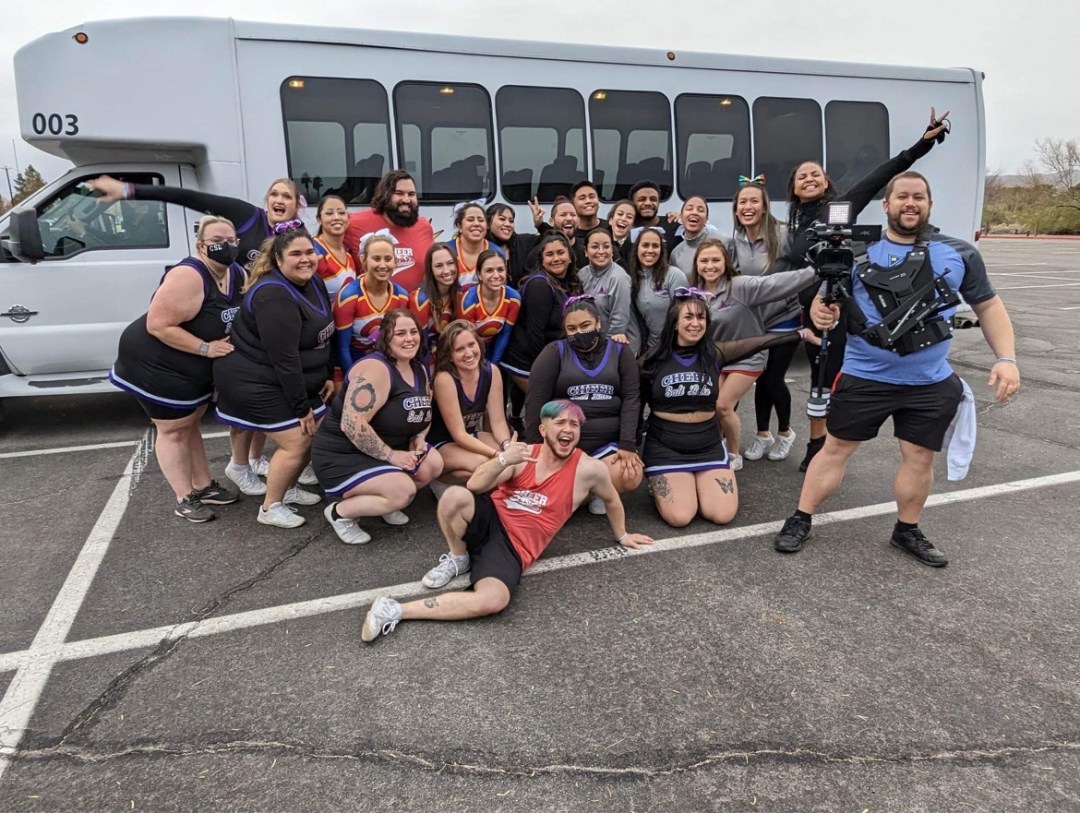
As I had been applying for PhD positions, still struggling with mental health, anxiety, and imposter syndrome, I was working to move ahead in my career and to put myself out there more as a sport psychology professional and work in sports. Facing a lot of rejections and spinning my tires in the mud, and just when I needed another boost of support, the Pride Cheerleading Association bursts through my door. I had already a previous working relationship with PCA via Compete Sports Diversity and I had been working on a project to develop my filmmaking hobby and to put myself out there more professionally. PCA invited me to bring my video camera and accompany them at the Sin City Classic to document and record all their adventures, leading me to my first episode of “Sport Psych n’ Stuff”, several articles on the experience (1) and (2), and some great content to highlight PCA as well. As a result, PCA helped me to gain valuable experience working as a sport psychology consultant with some of the athletes and teams, as well as the opportunity to put myself out there with the support of a literal team of cheerleaders.
Bringing it to more one on one, I have been grateful to connect with my colleague Julia, from White Lion Performance at the beginning of both of our journeys during the Master program. With her facing a lot of similar barriers and setbacks as an openly gay sports professional, we have come to support and rely on each other as peers and friends through many of these challenges. But rather than just survive, Julia has been instrumental into helping launch my career down new paths well above and beyond anything I could have ever achieved by myself. While I hope I am able to sufficiently reciprocate the love and support, Julia has worked harder and sacrificed more than anybody I know to make things happen for herself. She inspires me through her drive and resilience to succeed where others would most certainly fail.
From the Squid Swim Team to Compete Sports Diversity, SC Janus, Pride Cheerleading Association and White Lion Performance, all important members that exist independently within a larger LGBTQ+ sports community. These organizations have come together in their own unique ways to help support myself and my organization, Stonewall Performance, lifting me up to rise above the discrimination and move forward within the wider sports industry.
It is for that reason that I truly believe in the power of “community”, even when it feels most fragmented and incohesive, as we are still reliant upon each other not just to survive, but to thrive in even the most hostile climates. The presence and purpose of these organizations and people within this community highlight their common pursuit and goals within the greater field of sport. This greater sense of community and commonality is what drives these organizations to support each other within the greater “family” of the LGBTQ+ sports community who embody similar goals and pursuits. By building this platform on the shoulders of our peers, colleagues, friends, and “family”, we are developing the leadership and representation to rise above the prejudice and discrimination within sports in the hope that they will help make it a more accessible and inclusive space for all.

 stonewallperformance.com
One thought on “Finding the “Community” within the LGBTQ+ Community, and How They Are Helping Launch My Career in Sport Above and Beyond – A Retrospective Appreciation”